
Ad costs on the big platforms keep climbing. What is driving the increase, why chasing volume backfires, and the seven moves performance teams use to protect margin.
If your cost per lead crept up this month and you didn't touch the campaign, you're not imagining it. Paid media has gotten more expensive and less predictable in 2026, and the pressure is hitting almost everyone who buys on the major platforms. The good news is that rising costs don't mean paid acquisition stops working. They mean the margin for error is smaller.
How Bad Is It?
Numbers vary by source and portfolio, so treat these as signals rather than universal benchmarks:
- One agency tracking its own client portfolio reported Meta CPMs up 172% between January and June 2026, climbing every month after a January low.
- Another analysis put average CPMs up roughly a fifth year over year heading into 2026.
- On Google, average cost per click rose 16% to $5.42 in 2025, with high-ticket sectors like legal and finance seeing CPCs above $8. Conversion rates also improved, which softened some of the impact.
- Costs swing a lot month to month. One tracker showed Meta CPMs falling 18% in July, then costs rising again in September, with some verticals seeing CPCs jump nearly 70% in a single month.
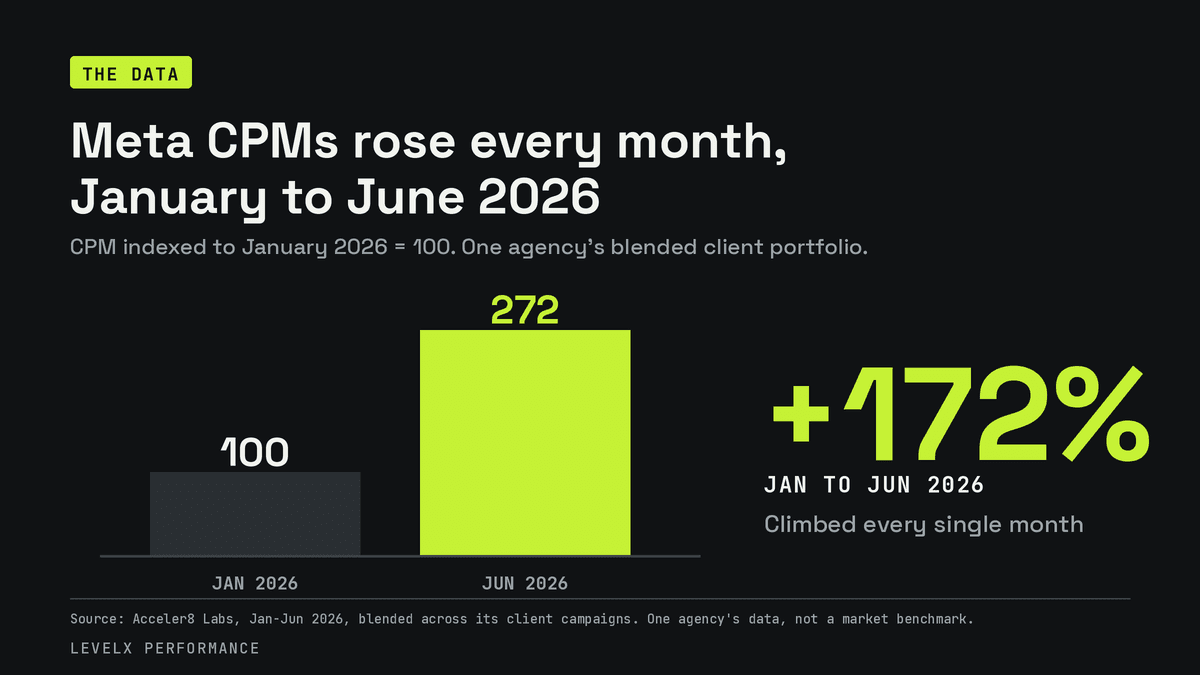
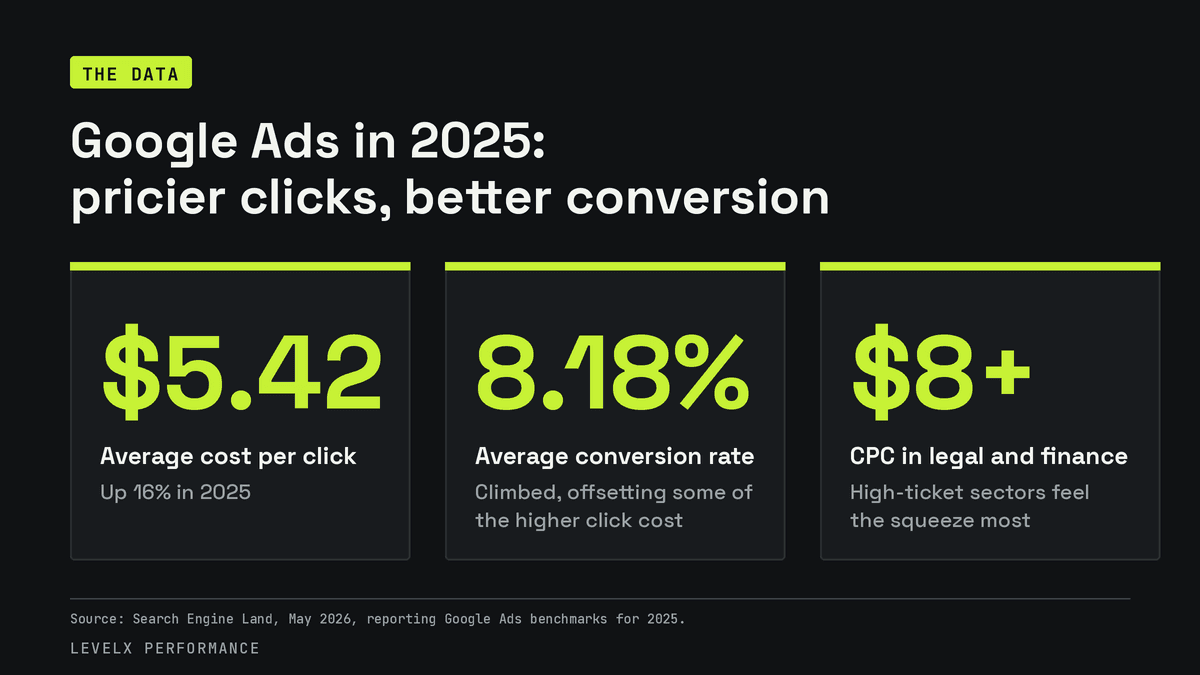
Takeaway: the trend is up, the path is bumpy, and planning around a flat cost assumption is risky.
Why It's Happening
- More competition. More advertisers, from small online stores to global retailers, are bidding for the same limited inventory.
- Limited supply. Prime placements on Google, Meta and TikTok are finite, so higher demand pushes prices up.
- Platform changes. Both Google and Meta have shifted toward AI-driven campaign systems that optimize for outcomes. Advertisers hand over more control, and results can swing for reasons unrelated to anything the marketer did that week.
- Privacy-related signal loss. Targeting and measurement are less precise than they used to be, and workarounds haven't fully closed the gap.
The Trap: Spending More to Make Up the Difference
When costs rise, the instinct is to increase budget to hit the same volume. That usually makes things worse. Raising spend into a more expensive auction means paying more for every conversion, which eats margin faster.
Here's the math behind it. Cost per conversion equals CPM divided by 1,000 times your click-through rate times your conversion rate. In an illustrative example with a $20 CPM, a 1% CTR and a 2% conversion rate, you pay $100 per conversion. If CPMs rise 50% to $30 and nothing else changes, that jumps to $150. But if you lift conversion rate from 2% to 3%, you're back to $100 even at the higher CPM.
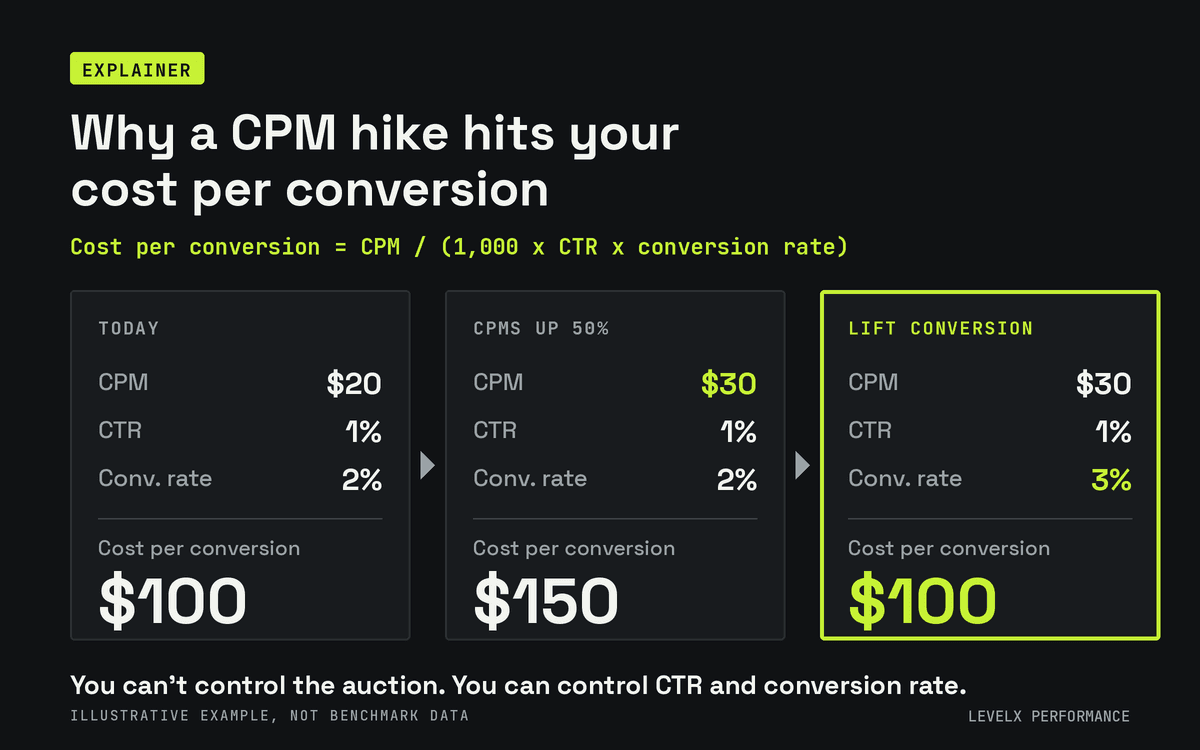
You can't control the auction. You can control CTR and conversion rate. The more reliable move is to make each dollar work harder, not to add more dollars at a higher price.
Seven Ways to Protect Margin
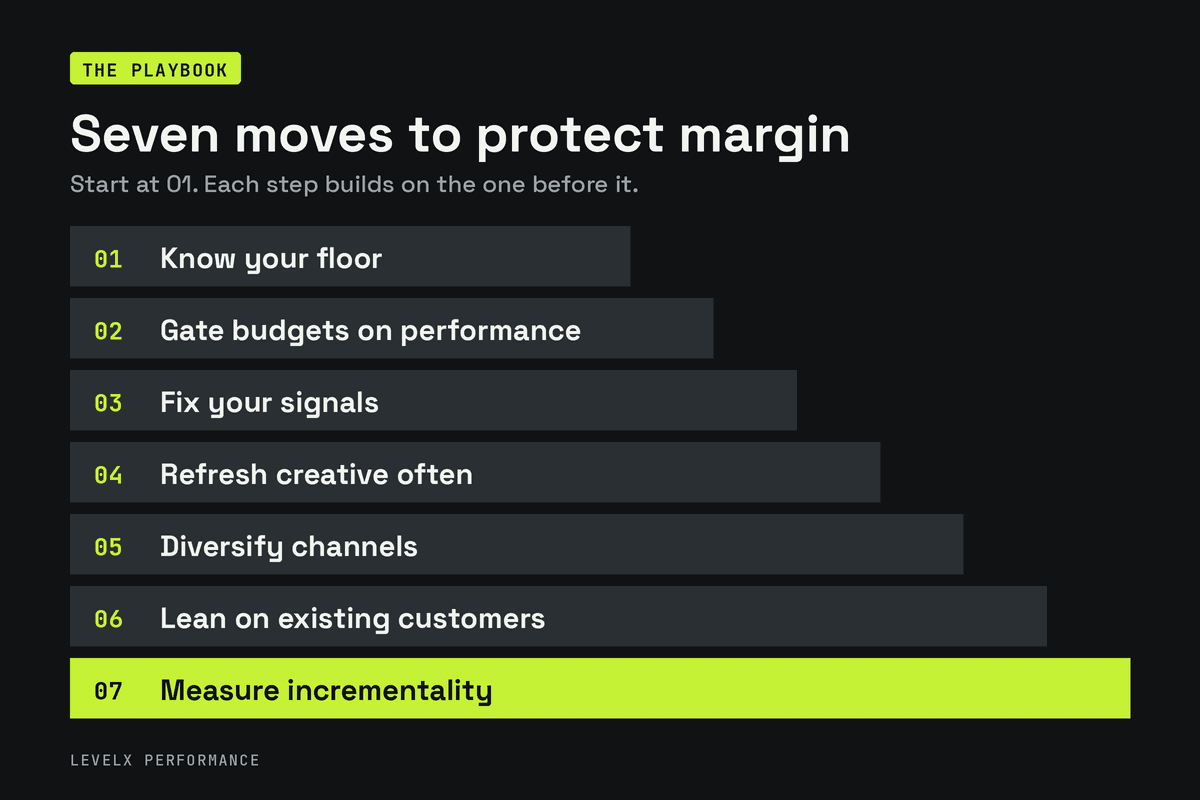
- Know your floor. Work out your break-even cost per acquisition and the minimum margin you'll accept. Without that number, you can't tell a rough week from a losing campaign.
- Tie budgets to performance, not flat amounts. Instead of locking in a fixed monthly spend, set gates so spend scales down automatically when the cost per result passes your threshold. That protects margin by design rather than by reaction.
- Fix your signals before adding budget. Platform AI systems optimize on the data you feed them. Clean conversion tracking, server-side postbacks and quality first-party data often close more of the gap than extra spend.
- Treat creative as your main lever. As targeting gets more automated, creative does more of the work. Refresh assets regularly, since fatigue shows up as rising click costs and falling engagement.
- Diversify channels. Some platforms, including Pinterest, Reddit and TikTok, have been reported to run at a fraction of Meta's CPM in the same period. Test them before concentrating more budget where prices are highest.
- Lean on existing customers. When acquisition gets expensive, retention and the contacts you already own become more valuable. Better follow-up on leads you've already paid for is often cheaper than finding new ones.
- Measure what's incremental. In a high-cost environment, paying for sales that would have happened anyway is a luxury. Holdout tests help you cut spend that isn't adding real lift.
Where Performance-Based Models Fit
Pricing models that pay on outcomes, such as CPA, CPL and CPI, tie your spend to results rather than to auction prices. When CPMs rise, the media-cost pressure lands on the publisher buying the traffic instead of directly on your budget. That doesn't make the risk disappear. Payouts still need to leave partners a viable margin, or quality traffic will move elsewhere. But it does give advertisers a more predictable cost structure than buying impressions in a volatile auction.
The Bottom Line
Rising CPMs are less a temporary spike than a new baseline to plan around. The teams that hold their margins won't be the ones who outspend everyone. They'll be the ones who know their numbers, protect their floor, feed the algorithms good data, and keep testing where costs are lower.
If you'd like to talk through how to build a more resilient cost structure, including how outcome-based pricing could fit, we're happy to help.
Sources
- 01Your Meta CPMs are up 172% since January — Acceler8 Labs
- 02Google and Meta Changes 2026: What Rising Costs Mean — Wooxy
- 03Google Ads costs keep rising, but conversion rates improved in 2025 — Search Engine Land (via Pulse)
- 04Meta ad performance trends 2026 — GeistM
- 05Meta CPMs are about to spike: here's your 6-week window to get ahead — Common Thread Collective
- 06Digital ad price predictions for 2026 — Extuitive